The rooftop of a building is one of the most common real estate ownership issues that gives rise to disputes among apartment and residential unit owners in shared residential buildings. Therefore, in this article, we chose to discuss the legal framework governing joint rooftop ownership.
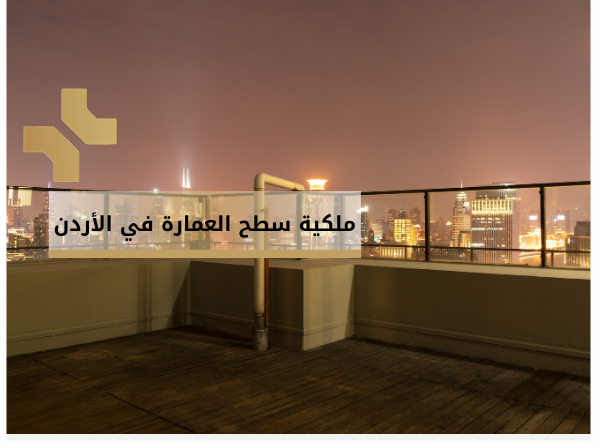
The rooftop of a building is the final floor of any residential property and the complementary level of the building, which is free of all construction occupancies except for water tanks and various types of satellite dishes.
According to common practice, ownership of the building’s rooftop belongs to the landowner on which the building was constructed, provided that this is stipulated in the sale contracts concluded with apartment owners. This means that the apartment owner owns only their apartment and the shared common areas jointly with all residents, such as elevators, staircases, walls, and others.
Continue reading this article to learn about the different types of rooftop ownership.
Under Jordanian law, there are multiple cases concerning rooftop ownership in residential buildings:
If the owner only rents out the apartments and residential units in the building without selling them, then the rooftop remains the property of the building owner.
If the provisions of lower and upper ownership (sufl and ‘uluw) apply, the rooftop belongs to the owner of the upper part.
In cases of ordinary co-ownership, the rooftop may be owned by several individuals, but only if they jointly decided to purchase the rooftop in undivided shares for the purpose of establishing a project on it.
Finally, the most common case of rooftop ownership is compulsory joint ownership, where the rooftop is owned by all residents of the building as compulsory joint property. In this case, the rooftop cannot be divided among apartment owners, and all owners have the right to benefit from it in full.
Ownership of the rooftop under compulsory joint ownership is inferred from the Jordanian law text stating:
(If the owners of the floors or different apartments of a building are multiple, they are considered partners in the ownership of the land and the parts of the building designated for common use among all, or any other part registered as such or required by the nature of the building to be shared, and this includes in particular the following):
● Foundations and main walls.
● Shared partition walls and walls designated for chimneys and roof support.
● Ventilation ducts for utilities.
● Roof supports, arches, entrances, channels, rooftops, staircases and their enclosures, corridors, hallways, floor bases, elevators, and guard rooms.
● Heating and cooling systems, all types of pipes, gutters, drains, shared installations and extensions such as lighting and water systems and their accessories, and everything that is part of the building except what is located within the individual floor or apartment.
The right of elevation is a real right granted to a specific person that allows them to build on the rooftop, without necessarily granting ownership of the rooftop itself. In other words, the rooftop may remain jointly owned, while the right to build on it belongs to a specific person.
Rooftop ownership means full ownership of the rooftop, whereas the right of elevation is merely a construction right without ownership.
| Clause | Rooftop Ownership | Right of Elevation |
|---|---|---|
| Nature of the right | Real ownership | Limited real right |
| Registration | Registered in the Land Registry | Registered as a right of elevation |
| Disposal | Sale / lease / mortgage | No |
| Construction | Permitted according to zoning | Permitted according to zoning |
| Land ownership | Yes | No |
| Legal origin | Joint | Exception |
The right of elevation is a legal right limited to construction above the rooftop without owning it. For this right to be valid, the following conditions must be met:
● It must be explicitly stated in the title deed.
● It must not conflict with applicable building and zoning regulations.
● An official building permit must be obtained from the competent authority (municipality).
● It must not compromise the structural safety of the building.
● It must not infringe on the rights of other owners in the common areas.
Private ownership of a building rooftop refers to ownership that is individually registered in the name of one person, making the rooftop exclusively owned by them. Accordingly, the owner has full rights to dispose of, use, or exploit the rooftop within the limits of the law. This includes the right to sell, mortgage, lease, or establish a private project on the rooftop, noting that the law does not recognize absolute ownership and therefore imposes certain conditions and restrictions.
You can review all conditions and restrictions through the following link:
Private Ownership of the Building Rooftop and the Rights Granted Thereof
Ordinary joint ownership of the rooftop has three cases:
A group of people purchases the building rooftop without owning any apartment or unit within the building, making the rooftop jointly owned among them.
The rooftop ownership is transferred to heirs from a deceased owner who owned the rooftop as an individually registered property.
Rooftop ownership arises as ordinary joint ownership due to explicit provisions in the property purchase contracts.
It should be noted that ordinary joint ownership of the rooftop includes several legal provisions:
● Use and exploitation of the rooftop: All partners may benefit from and exploit the rooftop without any partner having exclusive rights, and all partners must contribute to necessary expenses. The majority has the right to determine how the jointly owned property is used, and their decision is binding on the minority to prevent obstruction of use.
● Disposal of the rooftop: This includes disposal by all partners collectively, disposal of an individual partner’s undivided share, or disposal of a physically divided part equivalent to that share.
Compulsory joint ownership takes two forms:
● Original compulsory joint ownership: where the joint property exists independently and is not in service of individually owned properties, such as family cemeteries and their records, which cannot be divided and therefore remain jointly owned.
● Accessory compulsory joint ownership: where the joint property serves individually owned properties, such as pathways and roads connecting multiple properties.
In compulsory joint rooftop ownership, the legislator establishes rules regulating rooftop use among apartment and unit owners in the building. This is done after determining each partner’s share and clarifying the rights granted to joint owners over the rooftop.
You can review detailed provisions by clicking the link:
Provisions of Rooftop Ownership as Compulsory Joint Ownership
No. The rooftop is considered part of the common areas owned by all owners, and they all have the right to benefit from it unless explicitly stated otherwise in the sale contracts.
The general rule under Jordanian law is that the rooftop is part of the common areas and may not be sold or allocated without explicit legal authorization. The right of elevation does not constitute ownership and does not permit selling the rooftop.
The rooftop may only be sold if it is privately owned and officially registered.
Rooftop ownership belongs to the top-floor owner only if there is an explicit provision in the title deed, a registered right of elevation, or a formally registered agreement among all owners.
The Owners Association manages the common areas, including the rooftop, and has authority to prevent violations, regulate use, and resort to legal action when necessary.
You can do so by carefully reviewing the title deed, confirming the presence or absence of a right of elevation, asking the seller directly, or consulting a legal or real estate professional.
If you still have questions about rooftop ownership, do not hesitate to contact the Homes Jordan team for all legal and engineering consultations. Stay in touch with us through the following:
Phone: 00962791230777
Location: Homes Jordan Real Estate Offices
Social Media:
Facebook
Instagram
YouTube
LinkedIn
For direct inquiries, contact us via WhatsApp
All article rights reserved © Homes Jordan 2025
Sources: Rooftop Ownership

Real Estate Marketing in 2026
01-Apr-2026
Luxury furnished villas for rent in Amman 2026
23-Mar-2026
Real Estate Lands for Sale in Dabouq, Amman 2026
09-Mar-2026
 JOD
JOD AED
AED USD
USD